Launching a career in affiliate marketing without a website may seem like launching a career in car racing without a vehicle. How do you get started let alone find success without such an integral component?
Although a website does provide value, there are indeed many affiliate marketers who generate large incomes without one.
If you wanted to know if it’s possible to find success in affiliate marketing without a website, the answer is yes.
Is it recommended? How difficult is it? How is it accomplished? These questions require a little more time and detail to properly answer.
What is an Affiliate Marketing Website?
To better understand how to do affiliate marketing without a website, you first need to understand what exactly one is.
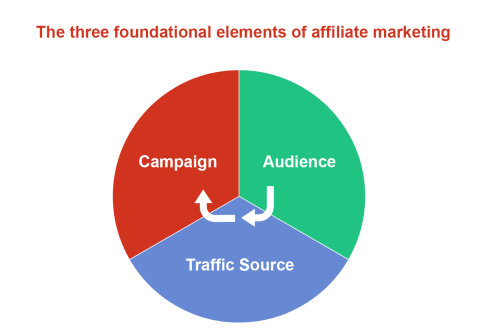
Think of affiliate marketing as being composed of three equal, necessary elements:
Campaign
The product or service you are advertising or promoting. These are found through affiliate/CPA networks like MaxBounty.
Audience/User
Who you are promoting the campaign to in hopes of generating a lead or sale. This will also determine your targeting which is a large component when promoting a campaign
Traffic Source
Where or how you are promoting the campaign to the audience/user. In other words, where are users seeing your promotional tactics for your campaign?
Most of the time, an ‘affiliate marketing website’ is referring to an owned and operated website that an affiliate marketer uses as a source of organic traffic. A website would function as the 3rd element above, although potentially in combination with other traffic sources as well.
Some affiliates choose to use websites they have either been operating from before they entered affiliate marketing, or that they have created for that purpose.
For instance, someone may have started a pet blog as a hobby and later decide they want to monetize through affiliate marketing. Alternatively, someone may want to get into affiliate marketing and want to combine it with their passion for sports, so they then start a sports blog.
Regardless, these were created by the affiliate with the purpose of receiving an influx of regular visitors. Those visitors would then have affiliate links promoted to them in the form of in-text links or banner ads.
There are several types of websites that can work for affiliate marketing including:
Personal blogs
Review sites
News sites
Educational sites
Essentially any type of website that receives visitors and has real estate for links or banners can work.
Now let’s look at the benefits of using one of these websites for affiliate marketing.
The Value of a Website in Affiliate Marketing
Although networks like MaxBounty may ask for a website URL in an affiliate application, it is not a mandatory field.
In other words, the outcome of your application is rarely dependent on whether or not you own a website. You can also link to other URLs in these fields that are not traditional websites, but that you still utilize to promote campaigns. We’ll discuss these in more detail later.
However, having your own website does undoubtedly provide several benefits. This is especially true if you have the desire to be an affiliate marketer long-term. These include:
The ability to capture leads to build a user/email list to promote future campaigns to
Free organic traffic from search engine users
The ability to utilize SEO to attract additional users
Greater overall control of your traffic source
All of the above are extremely valuable for any long-term career in affiliate marketing. Which is why we believe that anyone looking to become an affiliate marketer should highly consider creating a website.
If you perhaps have expertise elsewhere or have the desire to start immediately (creating a website and building a visitor base is certainly time consuming) affiliate marketing without a website essentially requires you to use other forms of traffic.
It’s important to note that some you would likely likely use some traffic types in combination with a website if you had one. It’s not always as black and white as: website VS non-website traffic types.
Now let’s look at your options if you were to take this route.
How to be Successful in Affiliate Marketing without a Website
Landing Pages Are an Affiliate’s Best Friend
Think of a landing page as the important connective tissue between your traffic source and the final sales page of a campaign.
Although a website isn’t necessary for success, it’s extremely rare to find a high-level affiliate marketer not using landing pages.
Now could a hosted landing page be technically considered a website? Possibly.
Like we mentioned above, a landing page URL is something you could even put in the website field when applying to MaxBounty if you don’t own a traditional website.
However, where websites usually have some element of navigation and multiple pages, a landing page is just that, a page.
It’s purpose is also more simplified.
It’s been proven that by bridging the gap between your traffic source (whether that be an ad, a social media post, or an email) and the campaign you’re promoting, you increase the chance of conversions.
That’s because your ads/promotion may have a different angle or theme than a campaign. A landing page allows you to utilize additional headlines, sales copy, and images to further sell the product or service prior to the sales page.
Some traffic sources will also prohibit direct linking to campaigns and thus a landing page then becomes a necessity .
If you need assistance in creating landing pages, check out our post Best Landing Page Builders for Affiliate Marketing.
Social Media Page or Group
Whether you’re a Facebook aficionado or an Instagram God, successful social media pages are one of the most popular ways to make affiliate marketing work without a website.
A high-follower social media page(s) basically operates as your affiliate marketing website if you don’t have a traditional one. It becomes your channel for organic traffic.
Now obviously growing a large following on Tik Tok, YouTube, or Twitter is easier said than done. However, as we mentioned above, some affiliates create a website prior to their affiliate marketing aspirations. The same applies to social media pages.
Social media also offers the unique advantage of allowing you to build a following at zero cost. If you eventually determine a budget, you can then start paying for ads within the platform to expand your following.
Again, a non-personal social media page is another URL that you can definitely use in the website field of MaxBounty’s affiliate application.
Paid Traffic/Media Buying
There are countless platforms online that allow affiliates to sign up and pay for traffic. This is also referred to as media buying.
Traffic platforms can range from gigantic ad networks like Google Ads to smaller ones that provide you with multiple types of web traffic.
The following are the most used and effective paid traffic types in affiliate marketing:
Search ads (Google PPC, etc.)
Native ads
Pop-up/Pop-under (also known as contextual)
Push notifications
Display/banner ads
Mobile/SMS
You can learn more about the different traffic types and where you can purchase this traffic by reading our Affiliate Marketing Traffic Source Guide.
If you have a budget to work with and have done your research, this can be one of the quickest and most effective ways to start affiliate marketing without a website. Just don’t expect immediate profitability.
Learning how to target the right demographic and geos as well as testing and optimizing your campaigns is going to play a large role in your media buying success.
E-mail Marketing
One might think that email would have surely lost some of its power as an effective marketing tool by now. It’s one of the oldest digital marketing strategies afterall.
This is simply not the case. In fact, email users are only going to grow.
Most people open their email multiple times a day, which creates a great opportunity to get affiliate links in front of a lot of eyeballs.
There are two ways you can approach using email for affiliate marketing: building an e-mail list on your own OR purchasing lists or a database to then target campaigns to.
If you are doing it on your own, you are going to need to encourage recipients to forward your emails and/or utilize other avenues like social media to build your list from scratch. Participating in cross-promotion with other affiliates can also be a great way to grow your list.
An added benefit of using email for affiliate marketing is you can continue to promote new campaigns to the same list once you’ve built one. With other forms of traffic you are usually starting from scratch each time you launch a campaign.
Email continues to be an effective albeit complex alternative to using a website in affiliate marketing.
Conclusion
Whether or not you use a website for affiliate marketing will likely be determined by:
Your time
Your budget
If you already have a website or not
Personal preference
Although we do recommend you use one if possible, it is not a prerequisite for success for affiliate marketers. You will just have to learn to become proficient at other traffic sources such as social platforms, media buying, or email.
The right combination of an affiliate network, campaign, traffic source, landing page, as well as an ability to test and optimize will always ultimately determine what level of success you reach in affiliate marketing.
The post How to Find Success in Affiliate Marketing Without a Website appeared first on MaxBounty Blog.
,