The bedrock of digital advertising — that’s third-party cookies, by the way — are not long for this world, causing the ad industry great difficulty when it comes to activating online ad campaigns.
In January 2020 the Google Chrome team confirmed it would align with other web browsers such as Apple Safari by sunsetting them, and, even if there have been multiple delays in this implementation, it appears as if this will be realized in 2024.
However, during the intervening two-plus years, the mailboxes of Digiday writers have been inundated with public relations messages from companies claiming to have found the solution. Notable among this deluge was news of Publisher Advertiser Identity Reconciliation (PAIR) from Google, which came out earlier this week. Read on for a (reasonably) pain-free explainer.
Okay, so what is PAIR and why is it important?
The death of third-party cookies has led to a rapid elevation in the importance of first-party data for marketers if they are to continue the execution of their online ad campaigns. But as successive recent surveys have noted, doing so at scale is just not easy.
PAIR is the latest solution on Google’s Display & Video 360, a.k.a. the most widely-used demand-side platform in the business or DV360, enabling advertisers to target online campaigns by cross-referencing their first-party datasets with relevant publishers.
Dan Taylor, vp of global ads at Google, noted how it lets advertisers and publishers “privately reconcile their first-party data for audiences” who have visited their respective online properties.
The cross-referencing of first-party data is performed at an aggregated level in order to safeguard any personal identifiable information shared with either of the primary partners with Google claiming that intermediaries (including itself) will not be able to hack any encryption.
“As a result, advertisers can show relevant ads to some of their highest-intent audiences, helping to increase advertising performance and hit marketing objectives,” added Taylor in a blog post.
But what does this mean? Isn’t it just more ‘clean room’ stuff?
Okay, here’s where we have to get somewhat technical, and (annoyingly) answer the above question by saying, “Well, yes and no.”
PAIR helps connect brands and consumers on relevant websites using common data points, with Taylor citing an example of a shoe brand uploading a customer relationship management database to pair with a relevant publisher via an email address, and then serve ads on its website.
While this sounds ideal, most marketers are concerned about using “pooled data” to target campaigns, although Google hopes to allay such concerns by guaranteeing that PAIR will let each brand and publisher maintain control of their data.
And yes, this will involve data clean rooms. PAIR can be described as a means of integrating with clean rooms via DV360.
How is this different than before?
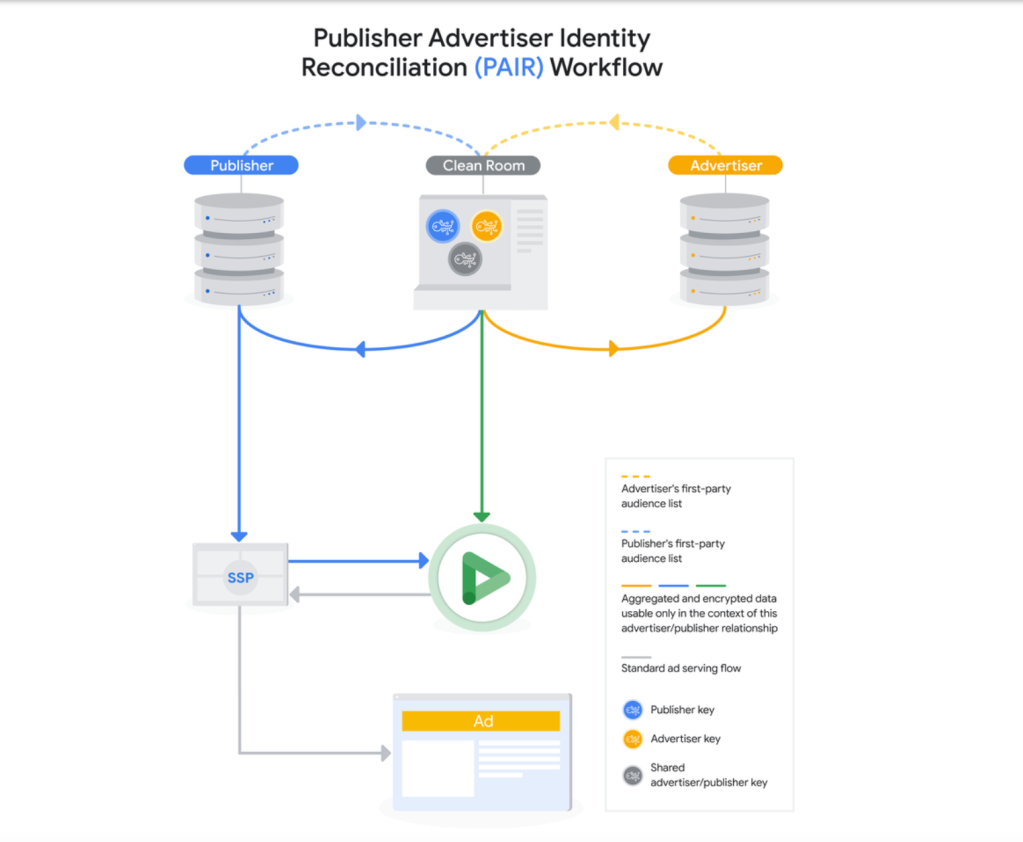
Here comes the science bit… and pay attention to the chart.
Image credit: Google
“PAIR also protects advertisers and publishers from data leaks by encrypting their first-party data three times with three different keys: an advertiser key, a publisher key and a key shared between the two parties,” Taylor added.
Google also maintains that there is no way to reverse-encrypt or identify users via this process as the transaction requires unique keys for each party involved. “After encryption and reconciliation, the advertiser and the publisher both receive the percentage match rate of their respective first-party audience lists,” Taylor said.
Who does this involve and who should care?
As mentioned, PAIR is the tech giant’s bespoke tool on the Google Marketing Platform, including DV360. Ergo, this has the potential to impact a lot of ad tech and nominally supply-side platforms that want to trade with the largest DSP in the business — incidentally, no PII will be shared with DV360 or an SSP.
Additionally, Google has also named three outside clean room providers — Habu, InfoSum and LiveRamp — as early test providers. “As we work to onboard more clean rooms, partners will have more choices,” noted Taylor, adding that plans are also afoot to integrate Google’s own solution Ads Data Hub with PAIR.