YouTube’s lowered mid-roll ad requirement may lead to shorter videos from publishers

Don’t be surprised if you soon start noticing publishers’ YouTube videos getting shorter. 

By the end of July, YouTube will reduce videos’ required length to carry mid-roll ads from 10 minutes to eight minutes, and publishers operating channels with millions of subscribers are welcoming the news as an opportunity to avoid extending the duration of their videos simply to reap the extra ad revenue. “A 20% decrease in how much content you need to create is not insignificant,” said one publisher.

The change may be an attempt by YouTube to remove the incentive for publishers and creators to pad their videos with extra content that only serves the purpose of ensuring a video qualifies to carry mid-roll ads. That can compromise the quality of videos and annoy viewers who sit through the interstitial ads only to be rewarded with filler content. Since the timeline in YouTube’s video player displays when a mid-roll ad will play, viewers may see a mid-roll ad is slotted near the end of the video, expect that the content after the ad will be filler and opt to stop watching before the ad plays, preempting the revenue that would have resulted for the video maker and for YouTube.

“You can tell when a video is stretched to be eligible,” said the publisher. Lowering the length requirement “will inherently enhance the quality of videos leveraging mid-rolls because you’re not stretching out for that duration.”

Short as two minutes may seem, meeting the 10-minute minimum can push publishers to produce an additional segment in a video, which can necessitate hiring more talent. “It should lower our cost per video slightly because we don’t have to put quite as much into it,” said a second publisher. In an economic downturn, any chance to cut costs can be a boon. Then there’s the potential for publishers to make more money from these shorter videos because of the additional ads they will be able to carry.

Publishers and individual video creators have prolonged their YouTube videos’ lengths over the past few years, in part, to prop up their revenue. As YouTube cracked down on brand safety following an advertiser outcry in 2017 after ads were found running against extremist videos, video makers saw increased instances of videos going unmonetized, and inserting multiple mid-roll ads in a video provided a means of offsetting the lost revenue. 

The addition of mid-roll ads typically increases a video’s revenue by about 50%, said a third publisher. The figure can vary, though, depending on how many mid-roll ads a video contains and how many viewers sit through those interstitials.

However, to meet the 10-minute threshold, some publishers and creators would fill their videos with bloat, like extending clips or replaying clips at the end of a video. “If you go to any channel with a lot of 10-minute videos, you’ll find a lot of comments where the audience even knows people are filling out the content to try to get it to 10 minutes,” said the third publisher.

By lowering the video length minimum, YouTube may reduce the incentive for publishers and creators to lengthen their videos purely for financial reasons. Or maybe not. YouTube allows channel owners to manually slot mid-roll ad placements in their videos and does not have clear limits on how many ads can be inserted. For the most part, though, publishers and creators are responsible and try not to insert mid-roll ads too frequently.

One creator told Digiday earlier this year that a best practice is to include a mid-roll ad every two-and-a-half minutes at most. Publishers and creators will need to see how many mid-roll ads viewers are willing to tolerate in an eight-minute video.

YouTube’s change could also spur a passive revenue boost for publishers because it will apply to the videos they have already uploaded to the platform. After seeing YouTube’s announcement of the shorter minimum, the first publisher analyzed its YouTube channels’ video libraries and found that one channel had roughly 500 videos that were between 8 minutes and 10 minutes in length. 

Considering YouTube’s reputation for long-tail viewership, the revenue from mid-roll ads being inserted into those videos could be notable, and even if not, it would be found money. “If you’re still doing pretty good viewership on your library, it’s like you’re getting a nice little raise,” said the first publisher.

The post YouTube’s lowered mid-roll ad requirement may lead to shorter videos from publishers appeared first on Digiday.
,Read More

Automotive, education publishers hit hard by malvertising attacks during the coronavirus crisis

Already feeling the pain from advertising pullbacks in the early throes of the coronavirus crisis, automotive and education publishers felt the brunt of malvertising attacks too.

Ad fraudsters saw the coronavirus pandemic as a prime opportunity to strike: CPMs had dropped as many advertisers paused or reduced their spend. With most people stuck inside under lockdown conditions, web traffic was surging — up 30% for news sites in March, according to Parsely data.

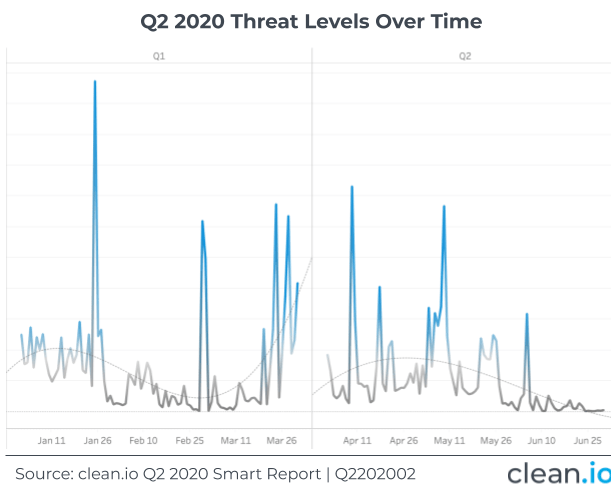
Clean.io, a company that offers malvertising protection to publishers, found that automotive publishers had the highest measure of its “global threat level” — a percentage calculation of the number of threats clean.io blocked divided by the number of pageviews it behaviorally analyzed — between April and June. A blended average of 0.28% of all automotive publisher pageviews Clean.io analyzed in the period were impacted by malicious ads. The single-day peak threat level for the category was 8.85%.

Clean.io estimated that on the worst-impacted days in the quarter, automotive sites without adequate ad fraud prevention could have lost 9% of their pageviews as user sessions were hijacked by redirects and illicit full-page takeover ads. 

Automotive publishers were likely hardest hit because they saw a shortfall in ad revenue as disruption to manufacturing and fewer visits to dealerships led carmakers to slam the brakes on their digital advertising. 

Overall, the level of malvertising observed across the 7 million websites and apps Clean.io analyzed “ebbed and flowed with with what we [saw] with [advertising] demand patterns throughout the quarter,” said Matt Gillis, Clean.io CEO. While the threat level was at its height at the beginning of April, it began petering out towards the end of May and June. That tallies the overall digital ad spending trends over the period: For most publishers, April was the bottom and revenue began ticking upwards again month-on-month in May and June. 

The next most-affected group of publishers were in the education category. A blended average of 0.27% of pageviews were affected by malvertising in the quarter. The single-day peak threat level was 2.86%. In this case, Clean.io said education publishers were likely hit due to receiving huge spikes in traffic as people adjusted to the new homeschooling environment. 

News sites were 20 times less likely to carry malvertising versus automotive and education sites, primarily because they are stricter about how they apply their price floors and have stricter ad-category blocks, according to Clean.io.

The majority of the malvertising occurred on mobile browsers, which is favored by fraudsters because they can take over the entire screen and masquerade as a landing page for a legitimate brand — such as an Amazon page or credit card company form — to encourage users to type in their personal information. 

“That’s the reason we think mobile is the platform of choice. It’s the same reason interstitials are a good way to get people to download an application,” Gillis said.

Chrome, which commands two-thirds of the global browser market, had the biggest share of attacks in the quarter at around 36% combined across its mobile and desktop browser. Perhaps more surprisingly, Facebook’s browser, embedded within its app, had the second largest share of attacks at 29% during the period analyzed. Malvertising issues inside the Facebook browser can be harder for publishers to troubleshoot and reproduce because it is one layer removed from the usual browser experience, Gillis said.

Facebook did not respond to a request for comment in time for publication.

Catching the criminals isn’t easy as they use sophisticated methods to avoid detection, including using a wide range of demand-side platforms and resellers to carry out their attacks. In the second quarter, Clean.io observed that the bad actors also rotated around more than 60 supply-side platforms, both large and small.

A spokesman for PubMatic said the company had seen a 100-200% increase in malvertising ads between March and June. However, the spokesperson added, the company had technology and 24-hour monitoring in place to protect publishers.

“Fortunately, we have restrictive bidding in place for most of our publishers. This means we only include good creatives in auctions and exclude those awaiting classification,” said the spokesperson.

A spokesperson for OpenX said they hadn’t witnessed a rise in the number of malvertising cases between last quarter and the beginning of this year.

“It’s been standard practice at OpenX to scan 100% of the ads that run through our exchange with multiple third-party malware detection platforms and to rescan all ad creatives based on risk assessment to ensure our publisher partners, and their users, are protected from bad ads,” the spokesperson added.

OpenX is also a participant of TAG’s Threat Sharing Group, which enables sharing of details on malware issues across DSPs and SSPs, the spokesperson said.

“We’ve always invested in and prioritized solutions that guarantee a protected and secure exchange, and as part of these efforts, have a working relationship with Clean.io to ensure we can be 100% confident the path to our supply is protected,” said an Index Exchange spokesperson.

A spokesperson for Magnite did not reply to a request for comment in time for publication,

Matt Cannon, chief operating officer of Venatus Media, a publisher monetization partner that works with clients in the gaming and entertainment industries, said SSPs do care about malvertising issues, but it can often be low priority. Venatus is a client of Clean.io.

“One of the biggest challenges is that the very nature of the dynamic of DSPs and SSPs and the way everything works means there’s no financial incentive for the demand side or the SSP pipes to proactively do something to fix this,” said Cannon. “It’s incredibly frustrating.”

The post Automotive, education publishers hit hard by malvertising attacks during the coronavirus crisis appeared first on Digiday.

,Read More