How news publishers are using the Olympics and AR to flex their emerging tech storytelling

The Washington Post and USA Today are using augmented reality to spotlight the sports new to the Olympic Games in Tokyo this summer, which kicks off today.

These AR initiatives are tests to expand their emerging tech capabilities and establish a pathway to turn around similar projects faster in the future. It’s a foray into a relatively new mode of storytelling made possible only at sizable publishers that have the funding and resources to experiment.

USA Today added two AR experiences around the Olympic Games to its mobile app on July 19:

One is narrated by professional skateboarder Tom Schaar, who gives a tour of the Olympic Games’ skateboarding course, displays simulations of skateboarding tricks, and provides a look at his careerThe other is narrated by Schaar and Olympic climber Krya Condie, who explain bouldering, scoring and different types of holds (the pieces on the wall that climbers grip). Condie describes how she tackles each wall, with videos of her past performances. An animated hand shows how to hold different grips.

These experiences are aimed at giving audiences a “better understanding of what to watch for [during the Games], the competition format and the scoring — and have the pro athletes be the voice that helps introduce them” to these new Olympic sports, said Ray Soto, senior director of emerging tech at USA Today’s parent Gannett.

USA Today has seen some success already for this kind of storytelling: AR stories had 15 million impressions and 1.5 million views across USA Today and other local apps, Soto said.

“We are seeing more and more engagement with interactive experiences,” Soto said.

The Washington Post has three AR and experimental video series that debuted on July 20, each on a new Olympic sport: climbing, skateboarding and surfing:

In one, Olympic climber Brooke Raboutou shoots up a 15-meter wall in about 10 seconds, which appears in your own space at scale when you launch the experience by scanning a QR code within the story on a phone cameraIn another, Olympic skateboarder Heimana Reynolds suspends himself in the air with 180 degree views in another experienceIn the third, Olympic surfer Caroline Marks rides a wave in a step-by-step, annotated slow motion capture video. 

The Post used motion capture for the first time to show the climbing AR experience — a strategy characterized by Elite Truong, director of strategic initiatives at The Post, as the publisher’s “take on motion capture and animation as a visual explainer.” To do this, editors created a 3D model of Raboutou from a photoshoot to show how she moves while climbing. For the skateboarding and surfing experiences, The Post used 36 GoPros to capture video that allows users to freeze the experience and take a 180-degree slow-motion view around the athlete.

For editors, it came down to storytelling.

“We could write a long paragraph on sprinting up a 50-meter wall in 10 seconds, but we try to figure out how to show that to you, in your own space, how tall 50 meters is,” Truong said. The Post declined to provide exact figures that speak to the popularity of this coverage — and the medium.

How publishers are investing in AR storytelling

Emerging tech is still a relatively new area of investment for publishers, many of which don’t have the resources to experiment, but Truong is convinced that it will “be everywhere” one day. “We will see more and more mainstream adoption,” she said.

There might be a fair amount of advertiser interest. Brands have gone from “testing out the marketplace to committing to pretty impressive investment in this space,” said Jason Steinberg, managing partner at Pretty Big Monster, a digital agency that has worked on web-based AR and VR experiences for brands like Sony Pictures.

Both publishers are working through where to offer readers these experiences. The Post’s AR coverage is now accessible by QR codes in articles, on the publisher’s app, iOS devices — and with its Olympics project — on Android phones. Previously, the experiences were exclusive to the publisher’s app which inadvertently “created a bit of the walled garden scenario” of inaccessibility, Truong said.

USA Today is adding capabilities to improve AR performance in-app. While AR experiences are only available on USA Today’s mobile apps, Soto said they are “exploring opportunities for web AR as well.”

How these publishers have structured their teams

Both publishers’ teams leading the foray into emerging technologies are made up of five people with backgrounds that range from product development to design. Neither company provided figures that speak to the amount of money they receive to experiment with new types of storytelling.

Truong said The Washington Post’s Lede Lab works on four to six large projects a year in a continuous trial and error. The team had a “big budget” for the Olympics project, which took about five months to complete, Truong said. She did not provide exact figures on what the monetary investment was, but said the team got “about a dozen smaller-scale learnings.”

USA Today has a similar goal. After the siege on the U.S. Capitol building on January 6, the emerging tech team built an AR package around the event in about eight hours. The idea is that more investigative, deeper dive stories will one day be considered premium content for USA Today subscribers, and AR projects built around breaking news will be free and accessible to all.

AR and VR experimentation should be left up to “the big guys” to gauge audience demand before other publishers jump on board, said Melissa Chowning, founder and CEO of audience development and marketing firm Twenty-First Digital. “It’s too expensive for most publishers without knowing if this is something their audiences even want,” she said, suggesting that most publishers should “let those with deeper pockets… be the early adopters.”

The post How news publishers are using the Olympics and AR to flex their emerging tech storytelling appeared first on Digiday.
,Read More

7 Free SEO Tips to Increase Organic Traffic to your Affiliate Site

Optimizing your affiliate site’s SEO is the number on way to drive more FREE organic traffic to your campaigns.

Even if you rely heavily on paid traffic, you should still place emphasis on improving the visitors who are finding your site through a Google search engine results page (SERP).

Lets look at some ways you can do just that quickly and without spending a dime.

Optimize for Google Passage Rankings

Last year, Google allowed for specific passages within a web page to be ranked for the first time. That means individual sections can be pulled and ranked independently of your main content.  

Use this current section as an example. Even though the topic of this post is on SEO techniques, this section on Google Passage optimization could rank on its own. This provides another avenue to try and get your site ranked at the top of a SERP.

Here’s what you can do to get your passages ranked well on Google.

Use proper heading formats and include relevant keywords directly in those headings.  Focus on a writing style that’s straightforward and easy to read.Ensure sections/passages make sense on their own while remaining relevant to the rest of the post.Repeat the keywords that are in your headings in your body copy.

Strive for Featured Snippets

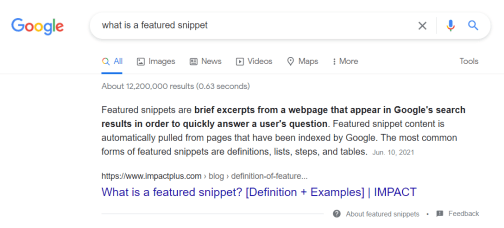
Featured snippets are the ideal outcome for anyone trying to improve their page’s ranking. They’re that highly coveted ‘position zero’ found at the very top of a SERP. Not only that but they stand out more than a traditional ranking because they include an actual snippet of your post’s body copy.

Let’s look at what you can to improve your chances of rising to the top.

Use longer keywords

The more words there are in a query, the more likely a featured snippet will be delivered to the searcher.  

SemRush determined that keywords of a single word have a 4.3% chance of producing a featured snippet, keywords of five or more produced one 17% of the time and those with 10+ did so 55.5% of the time.

With this in mind, try to match for phrases and definitions rather than just one or two keywords.

Insert Questions

With the rise of voice search, more people than ever are making search queries in the form of questions. Featured snippets are also often utilized as answers to those questions. Therefore, make sure to include those classic question words, specifically “who”, “do”, and “can” in your copy to position your content as a response. You’re essentially trying to provide a solution for a problem.     

Format for Quick Reading

The purpose of a featured snippet is to put easily digestible information immediately in front of a user. That means your most important and informative sentences should be near the top of your content with longer paragraphs following below.

For instance, if you’re writing a health-related post on what foods to eat to lower your cholesterol, one of your first sentences should be: The best foods to eat to lower your cholesterol are x, y, and z. Then you can provide secondary info and insight below.

Put More Emphasis on Link building

If SEO is still a relatively new concept to you, now’s a good time to know that link building or back links is/are a longstanding cornerstone of effective SEO and still is in 2021.

Backlinks can help improve your brand’s trustworthiness and image in the eyes of Google. This is accomplished by getting other reputable sites to include links to your site in their content.

This is primarily accomplished by doing the following:

Taking part in guest-posting partnerships with other sites/blogs.Searching for any unlinked mentions or topics and reach out offering links.Sharing your content on online forums and social media.

Just remember not to over do any of the above to the point of spam. Google will penalize you, tanking the very thing you’re trying to improve.

Write New and Re-Optmize Old

It’s important that your SEO strategy includes both producing new content AND improving old content. It can be easy to get stuck in doing just one but each provides unique set of benefits to improve your site’s overall SEO.

Why you should write new content:

Users look at dates and perceive more recent posts as having a greater chance of being relevant.“Freshness” is an element of Google’s ranking algorithm.  Writing new content gives you the opportunity to optimize for current SEO standards.

Why you should improve SEO for old content

Requires less time than writing new content but provides similar benefitsSmall improvements like fixing or adding new links can go a long way in improving SEO

Utilize Images. Properly

How important is it that you include images in your content? Well, 20% of ALL US web searches happen on Google Images. That’s a lot of traffic to potentially let slip by you.   

Images can improve your content in a variety of ways including SEO, but if not executed properly they can also hinder you.

First, make sure any images you use are both high quality and relevant to the topic you’re discussing. Low-quality, random images can quickly turn off any visitors by making your site come off as second-rate.

Conversely, high-quality means larger file sizes and slow loading times. This could impact your site’s loading time which is something Google considers when ranking sites. Even a single image could slow your site down enough to negatively affect your search ranking.

To ensure this doesn’t happen, you can utilize any online compression tool like tinypng.com or imagecompressor.com to reduce an image’s size without sacrificing quality.

Finally, you need to be making proper use of image alt tags. They’re important because search engines use them to associate keywords to your images.

The golden rule with alt tags is to include relevant info/keywords but to keep those limited. The image below illustrates the best way to approach this practice.

The post 7 Free SEO Tips to Increase Organic Traffic to your Affiliate Site appeared first on MaxBounty Blog.

,Read More