In Graphic Detail: Where brands stand when AI agents do the shopping

AI agents are becoming a new gatekeeper between brands and buyers, picking products by rules marketers don’t yet understand. Here’s what they need to know when navigating that shift.

Amazon keeps the toy aisle to itself

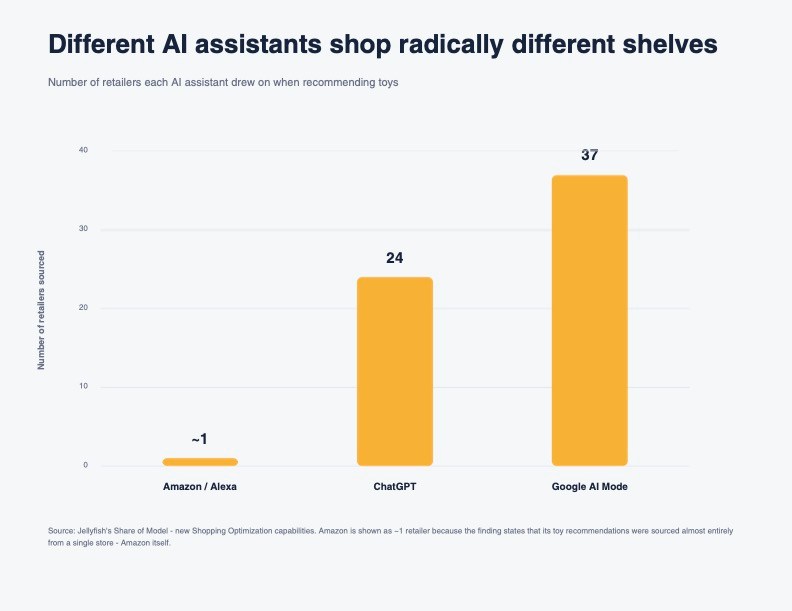
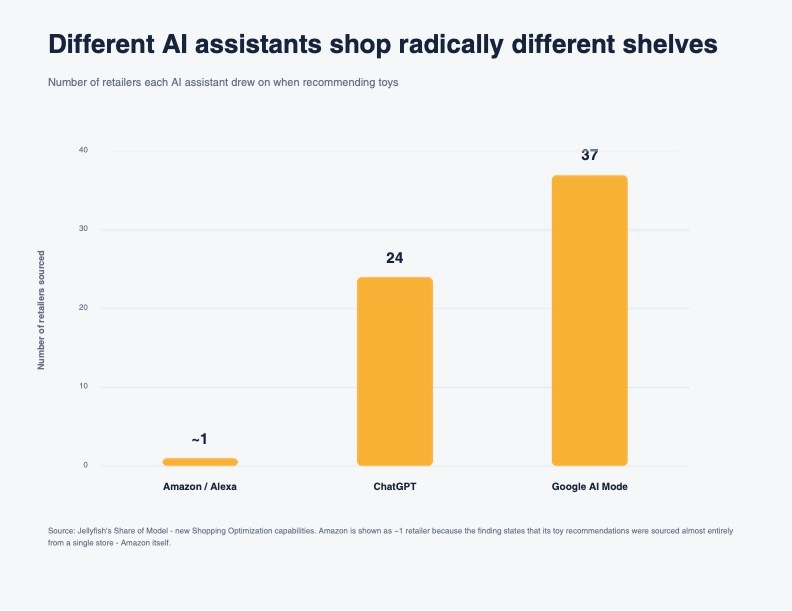
Alexa for Shopping showed toys from 177 brands when asked for recommendations and nearly every one of them came from Amazon’s own store. When the same request was asked of ChatGPT, the AI assistant recommended 24 retailers. Google’s AI Mode went to 37. AI visibility hinges on a brand being stocked in the stores each assistant is willing to look at, and which retailer lands the sale depends largely on which assistant the shopper happened to open. That’s the main takeaway from the analysis conducted by new shopping optimization capabilities within Jellyfish’s Share of Model tool, which tracked product recommendations from the three aforementioned assistants across eight categories in the U.S., U.K., Australia and Singapore.
Retailers get the biggest shelf space on Copilot

Of all the assistants, Microsoft’s Copilot cites retailers the most, according to Tinuiti. The agency tracked which e-commerce sites the assistants cited most often in answers to its prompts. In July, the top 100 made up 34% of Copilot’s citations. That’s more than triple their share on Google’s AI Mode and more than eight times their share on ChatGPT. Tinuti partly blames Reddit, which blocks Copilot’s crawlers and leaves more room for stores. Across all six assistants it tracked, retailers’ share slipped to 14% in July from $14 in Q2.

Continue reading this article on digiday.com. Sign up for Digiday newsletters to get the latest on media, marketing and the future of TV.

,Read More

OpenAI’s measurement gaps are keeping ChatGPT ads budgets at test level

Seven months after OpenAI started selling ads in ChatGPT, marketers are still asking how they’re supposed to measure them. It has become the sticking point in almost every conversation Digiday has had about the company’s progress as an ad seller. Part of the frustration comes from a sense that OpenAI hasn’t built much beyond the basics. Marketers’ own reluctance to trust the company with their data accounts for the rest.

On the product side, agencies running campaigns describe gaps that would be unusual on Google or Meta. Accuracast ran a U.K. lead-gen campaign on ChatGPT alone and watched the form fills come in, but two weeks later the platform still showed zero conversions. Accuracast’s group CEO Farhad Divecha, said the problem on Google and Meta tends to be the opposite, with the platforms claiming more conversions than they drove. The same agency found ChatGPT reporting around 100 clicks where its own tracking picked up 20, and OpenAI’s support team at the time couldn’t say why.

It’s far from a universal problem, though. Execs from AdRoll, Jellyfish and another independent U.S. ad agency said their execs hadn’t seen click discrepancies. For Web Guide Partner, though, it’s more about the timing of those insights. Where conversions do register on ChatGPT, the agency sees them arrive 24 to 36 hours late, against a few hours on Google. Reporting carries no demographic or prompt data.

Continue reading this article on digiday.com. Sign up for Digiday newsletters to get the latest on media, marketing and the future of TV.

,Read More